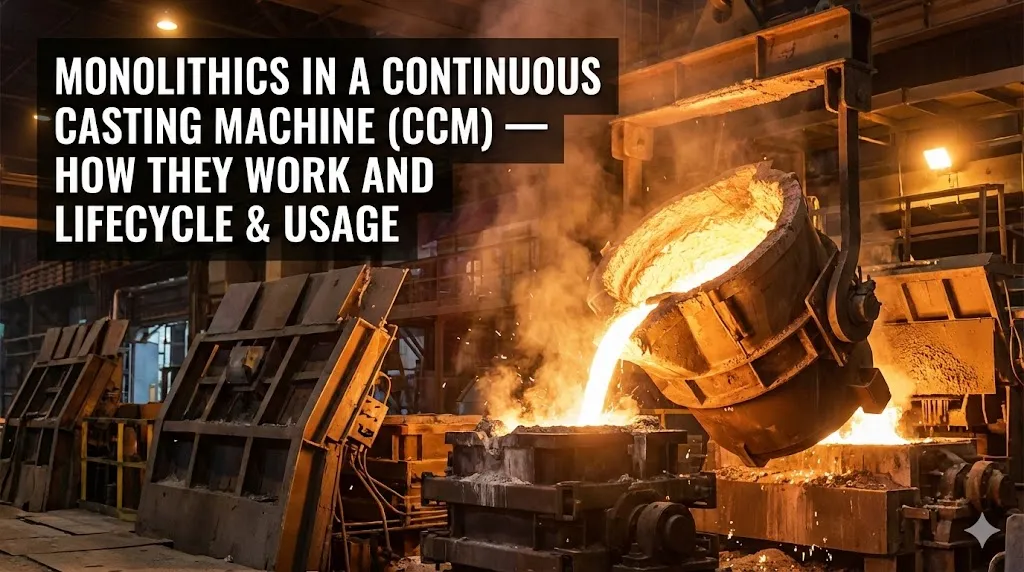
Monolithics in a Continuous Casting Machine (CCM) — How they work and lifecycle & usage

Monolithic refractories — often called castables, casting powder, ramming masses, or mortars — are unshaped refractory materials installed in place to form virtually joint-free linings. In CCMs they are widely used in tundishes, ladles, nozzles seats, stopper-rod wells, launder lines and lining repairs because they offer quick installation, tailored formulations, and good mechanical/thermal performance when correctly specified.

How monolithics work in a CCM (practical summary)

  • Function: Monolithics provide the working lining that resists thermal shock, chemical attack from slag/metal, abrasion from flowing steel, and mechanical impact. They are formulated from refractory aggregates (alumina, magnesia, silica, etc.), fillers and binders that harden in place (either hydraulic or chemical setting).
  • Typical forms & placement: Castables (poured or vibrated into forms), gunning (sprayed for repairs or shapes difficult to form), ramming (compacted for shapes needing high density), and dry vibrated mixes (for simple shapes). For a tundish or ladle lip/seat you’ll commonly see castable; nozzle seats and small repairs favour gunning for speed.
  • Performance drivers: Particle packing, low water content during installation, correct curing/drying, densification (vibration/compaction) and appropriate aggregate selection for the steel grade/slag chemistry determine life. Improper installation (high porosity, trapped moisture) causes premature spalling or abrasion.

Shelf-life / service life & lifecycle stages

  • “Shelf life” (storage): most dry monolithic products (castable/gunning powders) remain usable for months to a year if stored dry in sealed bags/pallets away from moisture and extremes of temperature. Check supplier SDS and lot expiry — some chemically-setting mixes have shorter usable windows.
  • In-service life (working life): highly variable — influenced by lining thickness, thermal cycling, steel grade and slag chemistry, flow-pattern and maintenance. A well-designed and installed monolithic lining in a tundish/ladle may last a single campaign (tens of hours) to multiple campaigns (hundreds of hours); but localised wear (nozzle jet, stopper-rod seats) typically requires targeted repairs much sooner. Precise life must be estimated from plant history and trials.

Recommended usage procedures & best practices

  1. ⁠Material selection: choose aggregate chemistry (Al₂O₃, MgO, SiO₂, mag-carbon, etc.) matching steel/slag and operating temperature.
  2. Proper storage: keep bags sealed, dry and off the ground; rotate stock (FIFO); avoid exposure to humidity.
  3. Correct mixing & low water content: follow supplier mix ratio; use mechanical mixers for castables to achieve uniformity and low porosity.
  4. Installation technique: castables — pour/vibrate and cure; gunning — use trained gunning operators and correct nozzle/air settings; ramming — compact to required density. Avoid trapped moisture.
  5. Controlled curing/drying: slow, staged heating to remove water and develop strength (prevent steam spalling). Some mixes require chemical set curing procedures.
  6. In-service monitoring & patching: monitor hot spots, use gunning for local repairs and plan relines during scheduled maintenance to extend campaign life.
Continuous Casting Process – Improving Steel Billet Efficiency

The Shift towards Continuous Casting
In the steel industry, billets form the foundation for bars, rods, and structural products. Traditional ingot casting, while effective in its time, created inefficiencies such as higher energy usage, longer lead times, and inconsistent billet quality. Today, the continuous casting process has become the global standard, offering steel producers an efficient, reliable, and cost-effective way to meet rising demand.
How Continuous Casting Works
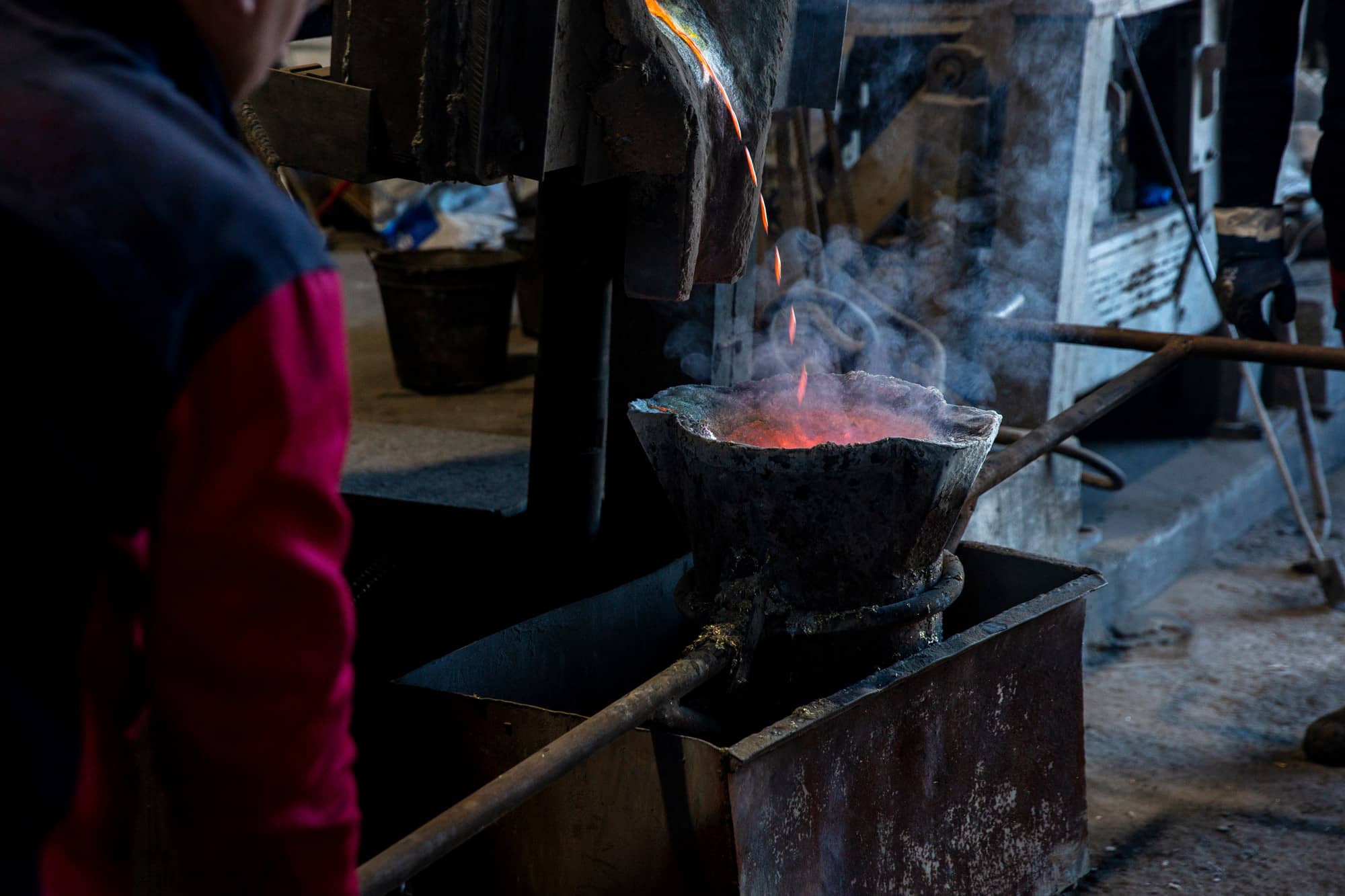
The process begins when molten steel is poured into a water-cooled mold. As the steel solidifies, it is continuously withdrawn and cut into billets of required length. Unlike older ingot-based methods, continuous casting eliminates the need for reheating and reduces rolling operations. This translates into higher productivity, energy savings, and fewer process interruptions.
Efficiency Gains in Billet Manufacturing
Continuous casting offers several operational advantages:
•⁠ ⁠Higher yield: More steel is converted into usable billets with minimal wastage.
•⁠ ⁠Consistent quality: Reduced segregation, porosity, and inclusions lead to billets with superior metallurgical properties.
•⁠ ⁠Cost efficiency: Lower fuel consumption and shorter production cycles help control costs.
•⁠ ⁠Scalability: Plants can achieve higher production volumes without compromising quality.
For procurement managers and engineers, these benefits mean predictable performance in downstream applications such as TMT bars, automotive parts, and construction steel.

Vendor Management & Supply Chain Integration
Efficiency in billet manufacturing must be supported by strong vendor management practices. Reliable sourcing of raw materials like iron ore, scrap, and ferroalloys ensures steady furnace operations, while coordinated logistics guarantee timely billet delivery to buyers. Manufacturers who integrate continuous casting with structured vendor evaluation, long-term partnerships, and transparent communication can maintain a resilient and cost-competitive supply chain.
Conclusion: Building a Competitive Edge
The adoption of continuous casting is more than a technological upgrade—it is a strategic move that improves operational efficiency, product quality, and sustainability. For buyers and importers, sourcing billets from plants that use continuous casting ensures consistency, reliability, and long-term value. In today’s competitive global market, continuous casting stands as the backbone of efficient, future-ready steel production.

Green TMT Bars – Market Size and Advantages

The global construction sector is shifting toward eco-friendly materials, and Green TMT bars are leading the way. With governments enforcing carbon-neutral goals and infrastructure projects emphasizing sustainable sourcing, the market size of green steel is projected to reach USD 320 billion by 2030, with TMT bars forming a strong share due to their widespread use in housing and infrastructure.
What makes these TMT bars “green” is their production process. Manufacturers use electric arc furnaces powered by renewable energy, recycle scrap steel, and implement energy-efficient methods that significantly reduce CO₂ emissions. These processes deliver the same — if not higher — strength and flexibility as conventional TMT bars while minimizing environmental impact.
For procurement managers and engineers, the advantages are clear: Green TMT bars support sustainability compliance (LEED, BREEAM), reduce long-term project costs with enhanced corrosion resistance, and align with global ESG requirements. Importers also gain a competitive edge by sourcing eco-friendly products that future-proof supply chains against stricter environmental regulations.
As demand for low-carbon construction materials rises, Green TMT bars are no longer a niche option — they are fast becoming a procurement standard. For global buyers, this is the right time to adopt sustainable sourcing and lead the transition toward greener infrastructure.