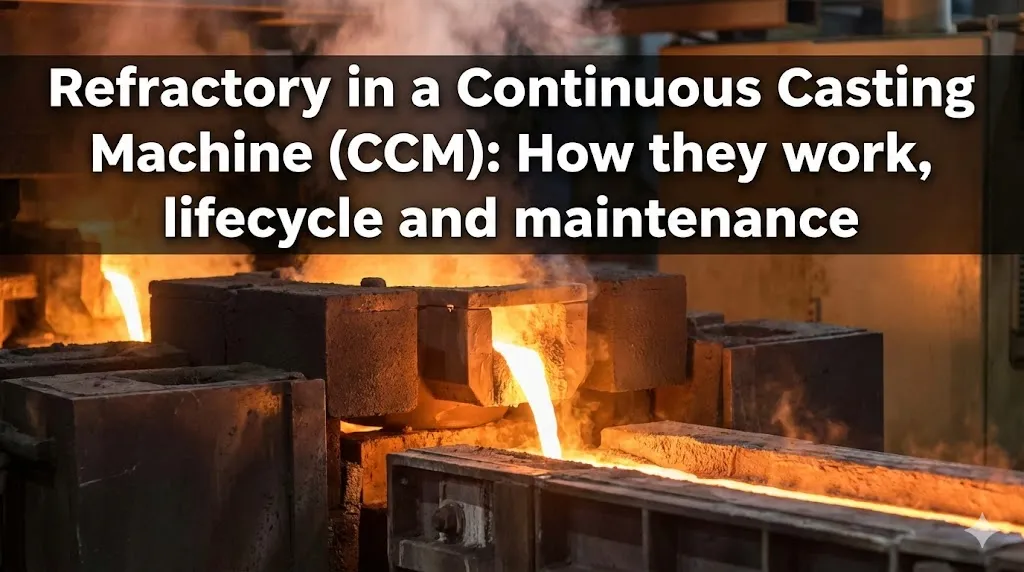
Continuous casting is the backbone of modern steel production. Two short-but-critical components in every CCM are the ladle (which brings molten steel from the furnace) and the tundish (the intermediate reservoir that feeds the mould).
Ladle: after steelmaking and any ladle treatment (alloying, degassing, temperature adjustment), molten steel is poured into a ladle. The ladle is mounted on the casting machine (often on a rotating turret) so one ladle can feed while another is prepared. From the ladle, steel flows through a refractory shroud/nozzle into the tundish.
Tundish: a shallow, refractory-lined holding bath between the ladle and molds. Its main roles:
- Serve as a buffer so the continuous caster keeps receiving metal during ladle changes.
- Regulate and smooth flow into moulds (ensuring steady filling across strands).
- Act as a metallurgical treatment zone — allowing inclusions/slag to float and some temperature homogenization.
- Provide a place for flow control devices (nozzles, stopper rods) and for tundish-specific flux/cover to trap impurities.
How it works:
- Ladle arrives at the turret; melt is checked for temperature/composition.
- Ladle is placed in on-cast position and the shroud/nozzle is connected to the tundish.
- Molten steel pours into the tundish; flow control (stopper rod or slide gate) meters steel to molds.
- When a ladle nears empty, the operator prepares the next ladle; tundish provides continuity while the swap happens. Avoiding “turnarounds” is critical — stopping the caster wastes time and requires fresh tundish handling.
Materials, refractory lining and typical service life
- Refractory lining function: thermal insulation, chemical resistance (against slag), mechanical wear resistance, and non-wettability to molten steel. Common working linings are disposable tundish boards or gunning mixes and include alumina, silica, and basic refractories depending on steel grade.
- Service life: highly variable — depends on lining materials, slag chemistry, casting sequences, thermal cycles and mechanical wear. Reported working-layer lives in literature can range from a single pour sequence up to many hours or multiple continuous pours — some studies quantify tundish working-layer lives in tens of hours (examples: service lives reported between ~18–26 hours in controlled studies, or increased life with optimized linings). Real industrial life is often judged per casting campaign and repaired/replaced as needed.
- Practical note: the tundish capacity is typically ~15–30% of the ladle volume, and tundish steel temperature is usually around 1510–1570 °C for typical steel grades — these factors influence both refractory stress and lining wear.
Usage procedures & life-cycle best practices
- Preheat & inspection: preheat tundish refractory appropriately, inspect for cracks/spalls before use.
- Controlled pouring & slag management: use tundish covers/flux to limit heat loss and reduce slag contact; deslagging procedures reduce chemical attack on lining
- Flow control & nozzle protection: use proper stopper rods/slide gates and well-designed nozzles/seat bricks to reduce localized jet wear
- Repair & refurbishment: use gunning mixes or castable refractory patches to repair hot spots during planned maintenance to extend campaign life.
- End-of-life handling: when wear reaches limits, remove, inspect and reline; poor dismantling practices cause spalling — controlled removal and optimized lining interfaces help life extension.