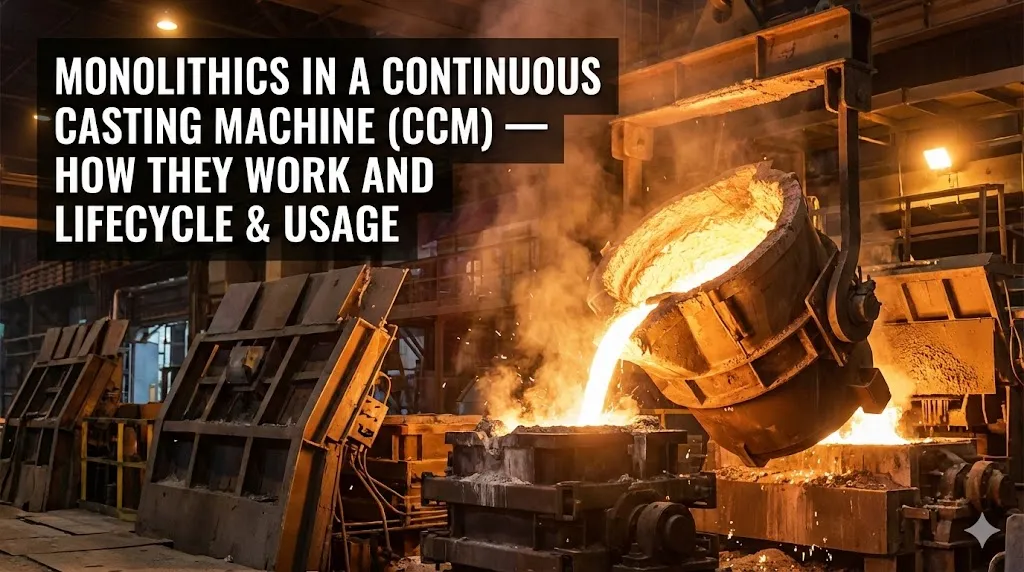
Monolithics in a Continuous Casting Machine (CCM) — How they work and lifecycle & usage

Monolithic refractories — often called castables, casting powder, ramming masses, or mortars — are unshaped refractory materials installed in place to form virtually joint-free linings. In CCMs they are widely used in tundishes, ladles, nozzles seats, stopper-rod wells, launder lines and lining repairs because they offer quick installation, tailored formulations, and good mechanical/thermal performance when correctly specified.

How monolithics work in a CCM (practical summary)

  • Function: Monolithics provide the working lining that resists thermal shock, chemical attack from slag/metal, abrasion from flowing steel, and mechanical impact. They are formulated from refractory aggregates (alumina, magnesia, silica, etc.), fillers and binders that harden in place (either hydraulic or chemical setting).
  • Typical forms & placement: Castables (poured or vibrated into forms), gunning (sprayed for repairs or shapes difficult to form), ramming (compacted for shapes needing high density), and dry vibrated mixes (for simple shapes). For a tundish or ladle lip/seat you’ll commonly see castable; nozzle seats and small repairs favour gunning for speed.
  • Performance drivers: Particle packing, low water content during installation, correct curing/drying, densification (vibration/compaction) and appropriate aggregate selection for the steel grade/slag chemistry determine life. Improper installation (high porosity, trapped moisture) causes premature spalling or abrasion.

Shelf-life / service life & lifecycle stages

  • “Shelf life” (storage): most dry monolithic products (castable/gunning powders) remain usable for months to a year if stored dry in sealed bags/pallets away from moisture and extremes of temperature. Check supplier SDS and lot expiry — some chemically-setting mixes have shorter usable windows.
  • In-service life (working life): highly variable — influenced by lining thickness, thermal cycling, steel grade and slag chemistry, flow-pattern and maintenance. A well-designed and installed monolithic lining in a tundish/ladle may last a single campaign (tens of hours) to multiple campaigns (hundreds of hours); but localised wear (nozzle jet, stopper-rod seats) typically requires targeted repairs much sooner. Precise life must be estimated from plant history and trials.

Recommended usage procedures & best practices

  1. ⁠Material selection: choose aggregate chemistry (Al₂O₃, MgO, SiO₂, mag-carbon, etc.) matching steel/slag and operating temperature.
  2. Proper storage: keep bags sealed, dry and off the ground; rotate stock (FIFO); avoid exposure to humidity.
  3. Correct mixing & low water content: follow supplier mix ratio; use mechanical mixers for castables to achieve uniformity and low porosity.
  4. Installation technique: castables — pour/vibrate and cure; gunning — use trained gunning operators and correct nozzle/air settings; ramming — compact to required density. Avoid trapped moisture.
  5. Controlled curing/drying: slow, staged heating to remove water and develop strength (prevent steam spalling). Some mixes require chemical set curing procedures.
  6. In-service monitoring & patching: monitor hot spots, use gunning for local repairs and plan relines during scheduled maintenance to extend campaign life.
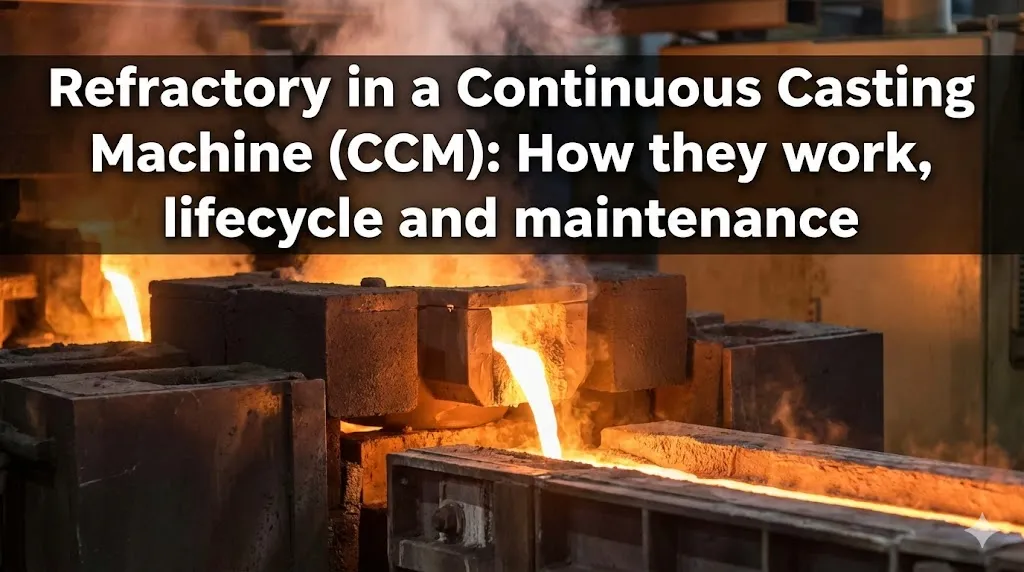
Refractory in a Continuous Casting Machine (CCM): How they work, lifecycle and maintenance

Continuous casting is the backbone of modern steel production. Two short-but-critical components in every CCM are the ladle (which brings molten steel from the furnace) and the tundish (the intermediate reservoir that feeds the mould).

Ladle: after steelmaking and any ladle treatment (alloying, degassing, temperature adjustment), molten steel is poured into a ladle. The ladle is mounted on the casting machine (often on a rotating turret) so one ladle can feed while another is prepared. From the ladle, steel flows through a refractory shroud/nozzle into the tundish.

Tundish: a shallow, refractory-lined holding bath between the ladle and molds. Its main roles:

  1. Serve as a buffer so the continuous caster keeps receiving metal during ladle changes.
  2. Regulate and smooth flow into moulds (ensuring steady filling across strands).
  3. Act as a metallurgical treatment zone — allowing inclusions/slag to float and some temperature homogenization.
  4. Provide a place for flow control devices (nozzles, stopper rods) and for tundish-specific flux/cover to trap impurities.

How it works:

  1. Ladle arrives at the turret; melt is checked for temperature/composition.
  2. Ladle is placed in on-cast position and the shroud/nozzle is connected to the tundish.
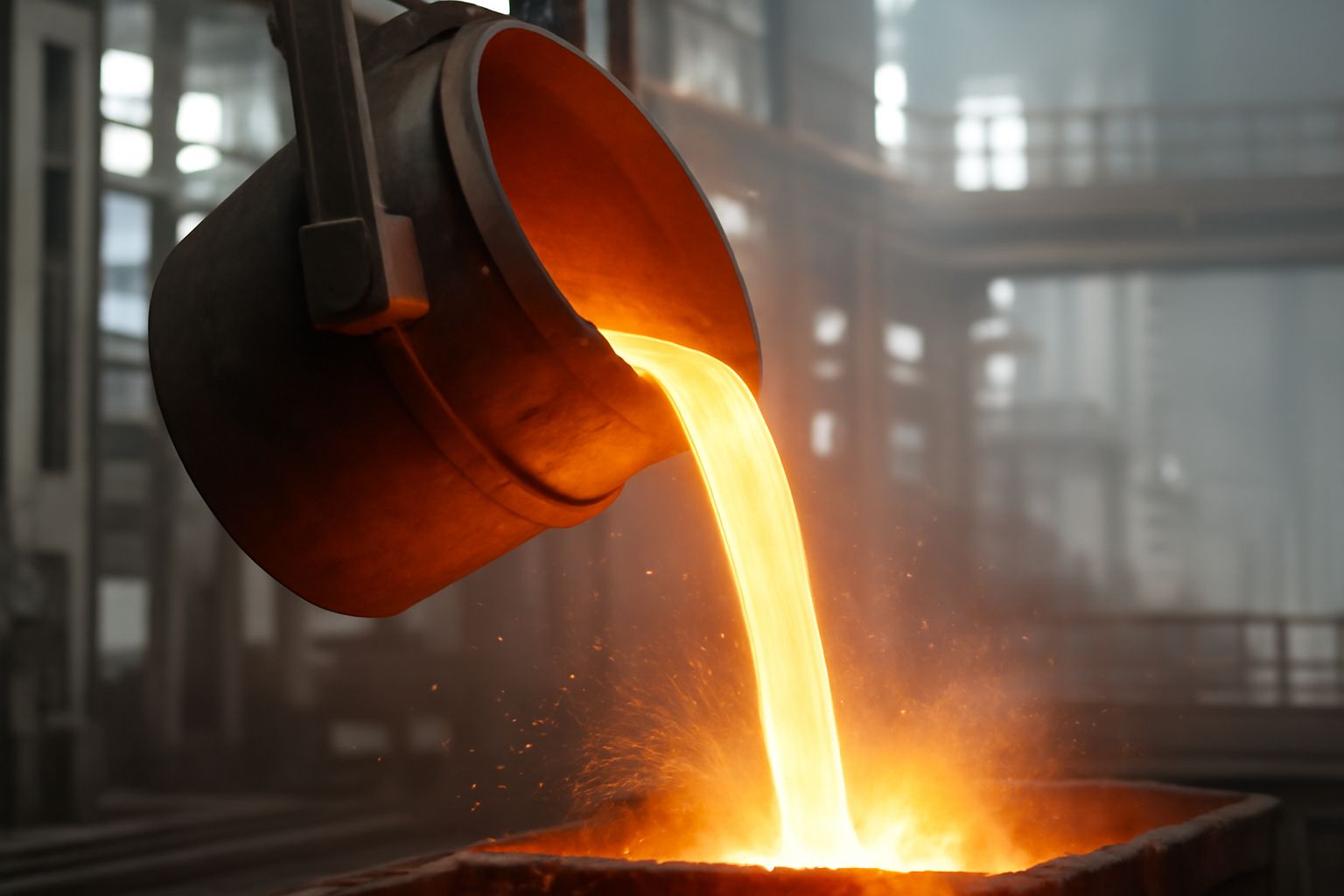
  3. Molten steel pours into the tundish; flow control (stopper rod or slide gate) meters steel to molds.
  4. When a ladle nears empty, the operator prepares the next ladle; tundish provides continuity while the swap happens. Avoiding “turnarounds” is critical — stopping the caster wastes time and requires fresh tundish handling.

Materials, refractory lining and typical service life

  • Refractory lining function: thermal insulation, chemical resistance (against slag), mechanical wear resistance, and non-wettability to molten steel. Common working linings are disposable tundish boards or gunning mixes and include alumina, silica, and basic refractories depending on steel grade.
  • Service life: highly variable — depends on lining materials, slag chemistry, casting sequences, thermal cycles and mechanical wear. Reported working-layer lives in literature can range from a single pour sequence up to many hours or multiple continuous pours — some studies quantify tundish working-layer lives in tens of hours (examples: service lives reported between ~18–26 hours in controlled studies, or increased life with optimized linings). Real industrial life is often judged per casting campaign and repaired/replaced as needed.
  • Practical note: the tundish capacity is typically ~15–30% of the ladle volume, and tundish steel temperature is usually around 1510–1570 °C for typical steel grades — these factors influence both refractory stress and lining wear.

Usage procedures & life-cycle best practices

  1. Preheat & inspection: preheat tundish refractory appropriately, inspect for cracks/spalls before use.
  2. Controlled pouring & slag management: use tundish covers/flux to limit heat loss and reduce slag contact; deslagging procedures reduce chemical attack on lining
  3. ⁠Flow control & nozzle protection: use proper stopper rods/slide gates and well-designed nozzles/seat bricks to reduce localized jet wear
  4. Repair & refurbishment: use gunning mixes or castable refractory patches to repair hot spots during planned maintenance to extend campaign life.
  5. End-of-life handling: when wear reaches limits, remove, inspect and reline; poor dismantling practices cause spalling — controlled removal and optimized lining interfaces help life extension.

Modern Steel Supply Chain and New Technologies

The steel industry supply chain spans multiple stages — from mining and processing to distribution and export. Traditionally, procurement managers and importers have faced recurring challenges such as price volatility, delayed shipments, and limited visibility into logistics. These inefficiencies add significant cost and risk to projects worldwide.
To address these gaps, the industry is embracing digital technologies. Artificial Intelligence (AI) helps predict demand and optimize procurement cycles. IoT devices now track shipments and warehouse conditions in real time, reducing losses. Meanwhile, blockchain technology is being piloted to secure contracts and provide transparent end-to-end tracking, ensuring product authenticity and compliance across borders.
The benefits are substantial: procurement managers gain predictability and transparency, engineers receive better quality assurance through traceable sourcing, and importers achieve faster, more reliable deliveries. Together, these innovations strengthen trust between suppliers and buyers in an industry known for its complex global trade routes.
Looking ahead, digital platforms, smart contracts, and AI-driven logistics will become the backbone of steel procurement. Companies that invest early in these technologies will reduce costs, comply with global standards, and emerge as preferred suppliers in the international market.

Global Demand for Ferroalloys and Their Role in Steel Manufacturing

Steel is the backbone of modern infrastructure, and ferroalloys are the essential ingredients that define its strength and performance. Ferrochrome, ferromanganese, and ferrosilicon are widely used in steel production to improve corrosion resistance, toughness, and de-oxidation. As global demand for high-quality steel increases, the need for reliable ferroalloy supply has become a priority for procurement managers and importers.

The ferroalloy market is currently valued at over USD 156 billion and is projected to grow steadily through 2030. Key drivers include rising infrastructure investments in Asia and the Middle East, increasing demand for stainless steel in construction, and the automotive industry’s shift toward lightweight but durable alloys. However, procurement professionals face challenges due to raw material concentration in specific regions, making diversification of sourcing critical for risk management.

From a manufacturing perspective, ferroalloys directly influence steel’s mechanical and chemical properties. For example, ferrochrome enhances corrosion resistance, making it ideal for stainless steel; ferromanganese improves strength and hardness; and ferrosilicon helps in de-oxidation, ensuring cleaner steel production. Engineers rely on the precise mix of these alloys to produce steel suitable for specialized applications ranging from construction to shipbuilding.

For buyers and importers, the outlook is clear: securing long-term, reliable sources of ferroalloys ensures consistent product quality and compliance with international standards. Strategic partnerships with exporters and producers not only reduce supply risks but also offer competitive pricing advantages in volatile markets. As the steel industry evolves, ferroalloys will continue to play a critical role in meeting global demand for stronger, more sustainable steel.

Continuous Casting Process – Improving Steel Billet Efficiency

The Shift towards Continuous Casting
In the steel industry, billets form the foundation for bars, rods, and structural products. Traditional ingot casting, while effective in its time, created inefficiencies such as higher energy usage, longer lead times, and inconsistent billet quality. Today, the continuous casting process has become the global standard, offering steel producers an efficient, reliable, and cost-effective way to meet rising demand.
How Continuous Casting Works
The process begins when molten steel is poured into a water-cooled mold. As the steel solidifies, it is continuously withdrawn and cut into billets of required length. Unlike older ingot-based methods, continuous casting eliminates the need for reheating and reduces rolling operations. This translates into higher productivity, energy savings, and fewer process interruptions.
Efficiency Gains in Billet Manufacturing
Continuous casting offers several operational advantages:
•⁠ ⁠Higher yield: More steel is converted into usable billets with minimal wastage.
•⁠ ⁠Consistent quality: Reduced segregation, porosity, and inclusions lead to billets with superior metallurgical properties.
•⁠ ⁠Cost efficiency: Lower fuel consumption and shorter production cycles help control costs.
•⁠ ⁠Scalability: Plants can achieve higher production volumes without compromising quality.
For procurement managers and engineers, these benefits mean predictable performance in downstream applications such as TMT bars, automotive parts, and construction steel.

Vendor Management & Supply Chain Integration
Efficiency in billet manufacturing must be supported by strong vendor management practices. Reliable sourcing of raw materials like iron ore, scrap, and ferroalloys ensures steady furnace operations, while coordinated logistics guarantee timely billet delivery to buyers. Manufacturers who integrate continuous casting with structured vendor evaluation, long-term partnerships, and transparent communication can maintain a resilient and cost-competitive supply chain.
Conclusion: Building a Competitive Edge
The adoption of continuous casting is more than a technological upgrade—it is a strategic move that improves operational efficiency, product quality, and sustainability. For buyers and importers, sourcing billets from plants that use continuous casting ensures consistency, reliability, and long-term value. In today’s competitive global market, continuous casting stands as the backbone of efficient, future-ready steel production.

Green TMT Bars – Market Size and Advantages

The global construction sector is shifting toward eco-friendly materials, and Green TMT bars are leading the way. With governments enforcing carbon-neutral goals and infrastructure projects emphasizing sustainable sourcing, the market size of green steel is projected to reach USD 320 billion by 2030, with TMT bars forming a strong share due to their widespread use in housing and infrastructure.
What makes these TMT bars “green” is their production process. Manufacturers use electric arc furnaces powered by renewable energy, recycle scrap steel, and implement energy-efficient methods that significantly reduce CO₂ emissions. These processes deliver the same — if not higher — strength and flexibility as conventional TMT bars while minimizing environmental impact.
For procurement managers and engineers, the advantages are clear: Green TMT bars support sustainability compliance (LEED, BREEAM), reduce long-term project costs with enhanced corrosion resistance, and align with global ESG requirements. Importers also gain a competitive edge by sourcing eco-friendly products that future-proof supply chains against stricter environmental regulations.
As demand for low-carbon construction materials rises, Green TMT bars are no longer a niche option — they are fast becoming a procurement standard. For global buyers, this is the right time to adopt sustainable sourcing and lead the transition toward greener infrastructure.